-
08-19 2026
Dust Removal and Explosion Prevention Systems Improve Overall Safety of Modern Steel Silo Grain Storage
With the large-scale and intensive development of grain storage and processing, grain dust generated during feeding, discharging and grain transportation has become one of the core hidden dangers in silo operation. Fine grain chaff, starch dust and dry crop debris accumulate inside steel silos and workshop spaces, forming flammable and floating dust environments. Without professional dust removal and explosion-proof configurations, even tiny static sparks may trigger safety accidents. As a professional manufacturer focusing on raw grain and feed storage equipment, Liaoning Qiushi Silo Equipment Engineering Co., Ltd. integrates standardized dust removal systems and explosion-proof designs into steel silo solutions, fundamentally improving the intrinsic safety level of grain storage projects.
-
08-06 2026
Wind and Seismic Resistant Structure Design Ensures Steel Silo Safety in Extreme Weather
Extreme weather conditions including strong gusts, heavy snowstorms and seismic activities pose major threats to large outdoor grain storage facilities. In many grain-producing areas of Central Asia, Russia and Northeast China, ordinary steel silos without professional structural reinforcement are prone to wall distortion, top deformation and even overall tilt under high wind pressure and snow loads. As a professional manufacturer focusing solely on raw grain and feed storage equipment, Liaoning Qiushi Silo Equipment Engineering Co., Ltd. adopts optimized wind-resistant and seismic structural design for all steel silo products, ensuring long-term stable operation of grain storage systems under harsh natural environments.
-
08-03 2026
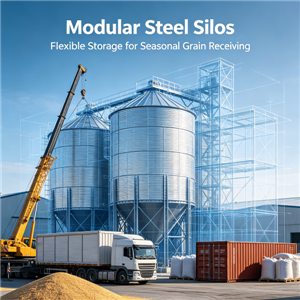
Transportation Adaptability of Modular Steel Silos Supports Mobile Grain Receiving Business
Seasonal grain purchasing is characterized by concentrated harvesting, short receiving cycles and scattered acquisition points. Traditional fixed concrete warehouses and large integral steel silos cannot be relocated, leading to insufficient storage capacity during harvest season and idle equipment for most of the year. Modular galvanized steel silos with detachable and relocatable features break the limitation of fixed-site storage, becoming the preferred storage equipment for mobile grain purchasing stations, seasonal grain collection points and temporary grain transfer yards. Focusing on raw grain and feed storage engineering, Liaoning Qiushi Silo Equipment Engineering Co., Ltd. launches detachable modular silo solutions tailored for seasonal mobile grain storage scenarios, effectively improving asset turnover for grain operators.
-
07-27 2026
Prefabricated Galvanized Steel Silos Deliver Predictable 15-Year Service Life for CIS Grain Storage Projects
A professional prefabricated galvanized steel silo is far more than a simple storage container. It is a complete engineered solution capable of reliable 15-year continuous operation, enduring frigid Russian winters, humid climates in the Russian Far East, and heavy dust loads at southern grain elevators. Liaoning Qiushi Silo Equipment Engineering Co., Ltd. has specialized in designing such silo structures since 2012. Years of field experience demonstrate that hot-dip galvanization effectively prevents corrosion under proper conditions, yet satisfactory performance cannot be achieved without standardized installation and targeted internal coating treatment. The company focuses exclusively on raw grain and feed raw material storage and does not provide storage solutions for industrial powder materials.
-
07-23 2026
Precise Grain Moisture Control Maximizes Silo Safety and Service Life in Long-Term Storage
In modern grain and feed storage management, most silo operation risks and grain quality losses are not caused by equipment defects, but by uncontrolled grain moisture. Excessive or uneven moisture in corn, wheat, rice and feed grain leads to spontaneous heating, mildew, condensation and internal wall corrosion, severely threatening both grain safety and silo structural durability. As a professional manufacturer focusing exclusively on raw grain storage equipment, Liaoning Qiushi Silo Equipment Engineering Co., Ltd. emphasizes that scientific grain moisture management is the core foundation for low-loss storage and long silo service life.
-
07-21 2026
Professional Galvanized Steel Silos Deliver Stable, Long-Term Grain Storage for Harsh CIS Climates
A qualified galvanized steel silo is far more than a conventional grain storage container. It is a high-precision engineered structure that integrates three critical performance advantages that are difficult to balance in ordinary storage equipment: reliable airtightness at ultra-low temperatures of -35°C, 15-year abrasion resistance against continuous grain friction, and predictable, controllable installation costs even in remote agricultural regions. With seven years of professional experience designing and manufacturing grain-specific silo systems, Liaoning Qiushi Silo Equipment Engineering Co., Ltd. has summarized that 82% of on-site silo failures across CIS markets are not caused by natural corrosion, but by improper selection of steel plate thickness, incorrect corrugation pitch, and non-standard flange connection designs during the early customization stage.
-
07-08 2026
Why Galvanized Steel Silos Outperform Concrete Warehouses for Modern Grain Storage
With the continuous upgrading of global grain circulation and standardized agricultural production, traditional concrete grain warehouses are gradually unable to meet the requirements of low-loss storage, intelligent management and rapid capacity expansion. More and more grain depots, rice processing plants and feed mills are eliminating old concrete warehouses and replacing them with modern galvanized steel silos, which have become the mainstream trend in the global grain storage industry. Professional in raw grain and feed storage, Liaoning Qiushi Silo Equipment Engineering Co., Ltd. explains why galvanized steel silos have become the preferred solution for new-generation agricultural storage projects.
-
04-27 2026
Liaoning Qiushi Shares Key Norms for Pneumatic Conveying in Steel Silos, Ensuring Safe and Efficient Grain Handling
In the modern grain storage and handling industry, the combination of steel silos and pneumatic conveying systems has become the mainstream solution for large-scale grain transfer, thanks to its sealed, dust-free operation, flexible layout, and high automation. As a professional enterprise dedicated to the R&D, design, and integration of steel silo and grain handling solutions, Liaoning Qiushi Vertical Silo Equipment Engineering Co., Ltd. has accumulated rich engineering experience in pneumatic conveying of grain in steel silos. Grain, as a special granular material, has the characteristics of low particle strength, easy breakage, and strong hygroscopicity, which puts higher requirements on the design, operation, and safety management of pneumatic conveying systems in steel silos. Neglecting key operational details may lead to pipe blockage, excessive grain breakage, and even serious safety accidents such as dust explosions. Based on years of industry practice, Liaoning Qiushi summarizes key norms and precautions for pneumatic conveying in steel silos, helping customers achieve safe, efficient, and low-energy consumption grain handling operations.
-
04-23 2026
Liaoning Qiushi Shines at the 20th Grain & Oil Food Industry Expo, Showcasing Cutting-Edge Grain Storage and Drying Solutions
As a professional enterprise focusing on the design, manufacturing, installation, and after-sales service of grain storage equipment, Liaoning Qiushi has always been committed to solving the core pain points of the grain and oil industry, such as high post-harvest losses, low storage efficiency, and complex environmental control. At the 20th Grain & Oil Food Industry Expo, we brought our star products tailored to the current market needs, including high-performance flat-bottomed steel silos, intelligent mechanical ventilation systems, and energy-efficient industrial drying towers, and demonstrated the complete process solutions for grain storage, ventilation, and drying through detailed technical displays and on-site consultations.
-
04-07 2026
Wheat Storage Steel Silo Project Helping Local Food Security Upgrade
We are delighted to announce the successful commissioning and handover of the 1,000-ton wheat storage steel silo project in Thailand. Located in a key agricultural and logistics hub of Thailand, this project is tailor-made to address the local demand for modern, efficient, and safe wheat storage, marking our important step in deepening the Southeast Asian grain storage market and demonstrating our professional strength in the global steel silo and grain industry.