
How to Choose the Right Grain Loading Process for Steel Silos?
The selection of grain loading processes should be based on grain variety, storage scale, site conditions, and investment budget. There is no one-size-fits-all solution; each process has its unique advantages and applicable scenarios. Liaoning Qiushi has successfully applied various loading processes in hundreds of global projects, helping customers optimize loading efficiency, reduce grain loss, and ensure storage safety. Below is a sorted and integrated introduction to mainstream processes, along with key comparison information and selection suggestions.
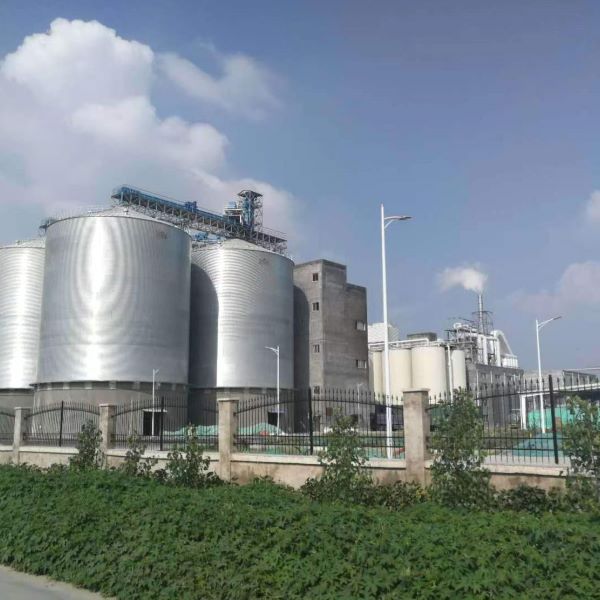
I. Core Grain Loading Processes: Integrated Introduction & Key Features
We integrate six mainstream processes into four categories based on their conveying characteristics and applicable scenarios, avoiding redundant repetition and highlighting practical guidance value.
1. High-Efficiency Conveying Processes (Suitable for Large-Scale Storage)
This category includes belt conveyor loading and bucket elevator loading, the two most widely used processes in large grain depots, ports, and processing plants, featuring high efficiency and strong adaptability to mainstream grains.
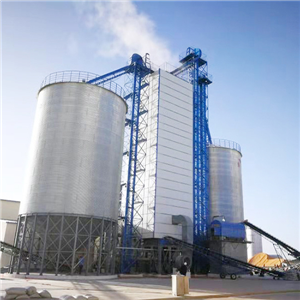
Bucket elevator loading is the most commonly used vertical conveying process. After grain is unloaded in the pit and cleaned, it is vertically transported to the top of the silo by a bucket elevator, and then evenly fed into the silo through chutes or distributors. It has the characteristics of high vertical conveying efficiency, small floor area, and moderate investment cost, suitable for both single silos and silo groups, and compatible with wheat, corn, rice and other mainstream grains. It only needs to configure horizontal conveying equipment on the top of the silo to realize multi-point loading. Liaoning Qiushi can customize the bucket elevator specifications according to the customer’s daily throughput to ensure matching with the silo capacity.
2. Uniform Distribution Processes (Suitable for Silo Clusters)
Scraper conveyor loading is mainly used for horizontal conveying on the top or bottom of the silo, suitable for large-scale steel silo complexes where multiple silos share a single conveyor line. It receives grain transported by the elevator and unloads it into the silo at multiple points along the track on the top of the silo, and can also be used for horizontal grain collection and transfer under the silo, realizing integrated loading and unloading. Its advantages are stable horizontal conveying, multi-point material distribution to avoid grain grading, good airtightness and little dust generation, which meets environmental protection requirements. The disadvantage is relatively high energy consumption and slightly more complex daily maintenance. Liaoning Qiushi provides customized scraper conveyor layouts according to the silo cluster design.
3. Low-Breakage & Flexible Processes (Suitable for Special Grains & Complex Scenarios)
This category integrates pneumatic pipeline loading and screw conveyor loading, focusing on low breakage or flexible short-distance conveying needs.
Screw conveyor loading is suitable for short-distance and low-flow auxiliary loading. It conveys grain horizontally or obliquely, directly feeding it into the silo opening or the inlet of the bucket elevator. It has the advantages of simple structure, small floor area, and low investment cost, but it is prone to causing grain breakage during conveying, so it is not suitable for long-distance or high-flow loading scenarios. Liaoning Qiushi provides small and medium-sized screw conveyors that match small silo specifications.
4. Emergency & Temporary Loading Process (Suitable for Flexible Supplementary Storage)
Mobile equipment loading uses a combination of mobile elevators, mobile belt conveyors, and grain suction machines to flexibly connect the grain unloading point and the silo opening, realizing mobile and temporary grain loading. It does not require fixed civil engineering, has high mobility and rapid deployment, and is very suitable for small warehouses, seasonal grain collection points, old warehouse renovation projects, and emergency loading operations. The only disadvantage is that its conveying efficiency is lower than that of fixed equipment. Liaoning Qiushi can provide matching mobile equipment according to the customer’s temporary storage needs.
II. Key Comparison of Mainstream Loading Processes
To help customers quickly select the suitable process, Liaoning Qiushi summarizes the core indicators of each process in a paragraphic way, replacing the traditional table form for more natural expression:
In terms of conveying efficiency, belt conveyors are the highest (★★★★★), followed by bucket elevators (★★★★☆), while pneumatic pipelines and scraper conveyors are at a medium level (★★★☆☆), and screw conveyors and mobile equipment are relatively low (★★☆☆☆). For grain breakage rate, pneumatic pipelines have the lowest rate (very low), followed by belt conveyors (low), scraper conveyors and bucket elevators are at a medium level (medium to medium-low), and screw conveyors have a relatively high rate (medium-high), with mobile equipment at a medium level. In terms of layout flexibility, mobile equipment and pneumatic pipelines are the most flexible (very high), scraper conveyors are at a medium-high level, bucket elevators and belt conveyors are medium, and screw conveyors are the lowest (low). Customers can make preliminary selection based on these core indicators combined with their own needs.
III. General Pre-Processing & Safe Operation Requirements for Grain Loading
Regardless of which loading process is selected, Liaoning Qiushi reminds customers to complete the following pre-processing steps and abide by safe operation norms to ensure grain quality and storage safety:
First, sampling inspection: Test the moisture content, impurity content, color, and odor of the grain; unqualified grain should be rejected or processed to meet storage standards before loading. Second, weighing: Record the gross weight of the grain, then unload and weigh the tare weight, calculate the net weight, and keep detailed records for future reference. Third, initial impurity removal: Use cleaning sieves and magnetic separation equipment to remove large and small impurities and metal debris, ensuring the purity of the grain entering the silo. Fourth, loading operation: Adopt the selected loading method to feed grain into the silo, ensure even distribution, control the drop height of the grain, and minimize breakage and grading. Fifth, process monitoring: Randomly inspect the grain quality during the loading process, observe the grain flow and distribution, and promptly handle any abnormalities. Sixth, safe operation: Strictly implement fire prevention, explosion prevention, and dust prevention measures, and operate all equipment in accordance with standard procedures to avoid safety accidents.
IV. Professional Selection Guidance from Liaoning Qiushi
When selecting a grain loading process, Liaoning Qiushi suggests customers focus on three core dimensions to ensure the rationality and applicability of the solution: